Tony Levin – sad news

The great drummer Tony Levin died yesterday (February 3rd).

My impression was that Tony was one of the first drummers in the UK to have understood and developed Elvin’s thing if not the first). While these days we can access transcriptions and videos effortlessly, it is easy to ignore the pioneering work of the British jazz musicians in the 1960s and 70s, who internalised the very complex music from the USA at the time. It was certainly harder then. But Tony was also an incredible improvisor and creative musician. Typically of the British scene, I can recall some folk saying that he was too loud, but it is the usual issue of some British horn players not “getting the drum thing”. The truth of the matter is that he was active and dynamic, making things happen. Click here…

Tony was generous, kind and I wish that I could have played with him when I was considerably more experienced. In my formative years, he provided me with the opportunity to play with a host of great British jazz musicians (Ronnie Ross, Art Themen, Pete King etc) at his gig at the Barton Arms in Birmingham (in 1985 I think). There was also a thrilling night with Red Rodney.

Tony Levin was musician to whom I owe much.
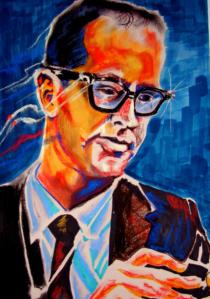
Paul Desmond, a master mind and wit: some thoughts for a New Year

A poet of the music, Paul Desmond was both self-deprecating and deeply insightful. This medley of quotes might tickle and provoke us…
“I tried practicing for a few weeks and ended up playing too fast… I have won several prizes as the world’s slowest alto player, as well as a special award in 1961 for quietness”.
Regarding his tone:“I honestly don’t know! It has something to do with the fact that I play illegally.”
On why he changed his name: “Breitenfeld sounded too Irish.”

More seriously, Paul Desmond challenges students and teachers of the music: “Complexity can be a trap. You can have a ball developing a phrase, inverting it, playing it in different keys and times and all. But it’s really more introspective than communicative. Like a crossword puzzle compared to a poem.”
And most telling… “Writing is like jazz. It can be learned, but it can’t be taught.”
Sadly his perception about the jazz audience appears to remain pretty much spot on…”Our basic audience begins with creaking elderly types of twenty-three and above.”

For more Paul Desmond, click here:
www.jazzquotations.com/2010/05/paul-desmond-quotes_24.html
thinkexist.com/quotes/paul_desmond/
www.gandalfe.net/paul_desmond.htm

For a transcription of Paul Desmond’s solo on “Samba with some Bar-B-Q” click here

The Improvisational Brain – new article

Musicians and students are prone to a bit ranting as to how improvisation occurs and whether or not the analogy with language acquisition is appropriate. In supervising students’ (and their own) personal practice, teachers of improvisation can encounter blocks to progression and development, spending a lot of time untangling a student’s perception of their learning experience.

Those moments hit us all!

While Improvising is fun, once studied or practiced, it is my experience that inexperienced students and some seasoned musicians can mistake the sensations associated with play or the “flow state” with the slower and “creaky” mind that learns the initial stages of concrete skills. You  might say confusing the self-expressive state is confused with the learning state.

“Watching a musician in the throes of an improvisational solo can be like witnessing an act of divine intervention, but embedded memories and conspiring brain regions, scientists now believe, are the source of ad-hoc creativity” So suggests Amanda Rose Martinez see her article in SEED MAGAZINEclick here.

I suggest that our experiences as students of improvisation will be easier if we undertstand the learning process, so thank you Ms Rose… but now the community of jazz educators will be well advised to consider precisely how the research can be applied to enhance schemes of work, learning strategies and practice in general – and to be fair, the findings of this research have been alluded to for at least 30 years through applied (as distinct to cognitive) psychology. This is where the work of figures such as Guy Claxton et al, George Odam and the tried and tested Inner Game authors is useful.

What’s stopping us?

The Curriculum – all that is taught and learnt…

The Curriculum – all that is taught and learnt…
Core and hidden…
Planned and received…
Formal and informal…


Can we have an informed debate please?

We find ourselves in an historic time when education is about to the redefined by the course of political determination, we would be well advised to be mindful of the purpose of education and how teaching and learning occurs. While the nature and content of learning experiences have already changed due to the technological revolution, for whatever reason and whatever political persuasion suits you or I, the presence and provision for a range of subjects and learning processes are possibly about to change through a course of action that will be described as progressive, radical, essential, urgent… or reactive, dangerous and without educational rationale – depending upon your perspective.

Would it not be prudent to be informed? Even if a radical reassessment is necessary, all parties would be better served through deep consideration and evidence-based understanding of the core issues. Vic Kelly understood the curriculum and engages us in a thorough consideration of the psychological, philosophical, political and operational drivers that form the learning culture of schools and colleges. Derived form a latin word referring to a race track, perhaps we should prefer curriculum is less of a race to acquire information, and more a consideration of “all that is taught and learnt”, built upon values as much as operational mechanics and transient values.

A.V.Kelly’s “The Curriculum: Theory and Practice” – click here.

Simon Purcell 5tet @ London Jazz Festival – November 19th

SIMON PURCELL QUINTET – London Jazz Festival on Friday 19th November 2010

The quintet (with Chris Batchelor, Julian Siegel, Gene Calderazzo and Steve Watts) will be performing at the free stage in the Royal Festival Hall from 1 – 2pm on Friday November 19th.